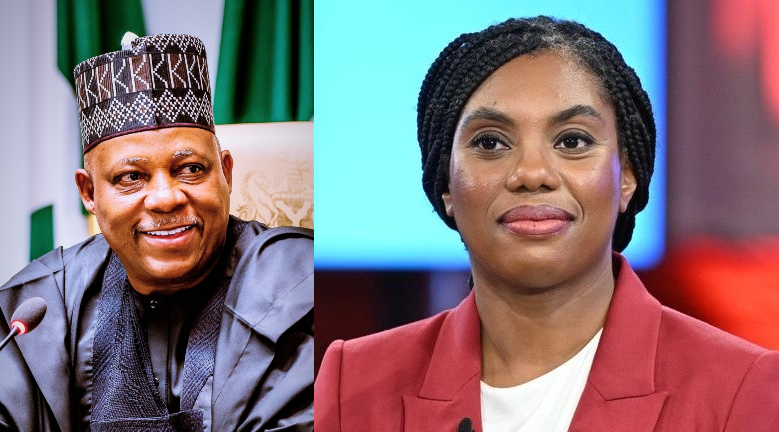
In a recent public address, Nigeria’s Vice President Kashim Shettima has admonished Kemi Badenoch, the newly elected leader of the UK Conservative Party, for her critical remarks about Nigeria. Shettima suggested that if Badenoch is not proud of her Nigerian heritage, she should consider dropping her Nigerian name. This statement has ignited a heated debate about national pride and the responsibilities of public figures regarding their countries of origin.
Background of the Controversy
The controversy stems from Badenoch’s previous comments about her experiences growing up in Nigeria, where she described the country as a place filled with fear and instability due to corruption and poor governance. In various interviews and speeches, she has expressed her disillusionment with the political landscape in Nigeria, stating that she witnessed firsthand how politicians mismanaged public funds.
During a recent trip to the United States, Badenoch remarked on her childhood in Lagos, highlighting the oppressive environment under a military dictatorship and the economic challenges her family faced. Her candid reflections have drawn both support and criticism, particularly from Nigerian officials who feel that her comments undermine the country’s image.

Shettima’s Remarks
Speaking at the 10th Annual Migration Dialogue in Abuja, Shettima emphasised that while Badenoch is entitled to her opinions, her remarks could be seen as denigrating Nigeria. He stated, “If she is not proud to be from Nigeria, she has every right to remove Kemi from her name.” He contrasted her comments with those of Rishi Sunak, the UK’s former Prime Minister of Indian descent, who he claimed has never belittled his heritage.

Shettima expressed pride in Nigeria’s global contributions and its diaspora, asserting that “Nigeria remains the greatest Black nation on earth.” He urged Nigerians abroad to celebrate their roots and contribute positively to their homeland’s image rather than disparaging it.
Badenoch’s Response
Badenoch’s spokesperson responded to Shettima’s comments by reaffirming her stance on Nigeria. The spokesperson stated that she “stands by what she says” and is “not the PR for Nigeria.” They pointed out that Badenoch speaks the truth based on her experiences and will not shy away from addressing difficult topics.
Despite the backlash, Badenoch has maintained that her criticisms are rooted in reality and serve as a wake-up call for Nigerian leaders to address systemic issues. Her remarks have sparked discussions about the role of diaspora Nigerians in shaping perceptions of their homeland.
Public Reactions
The exchange between Shettima and Badenoch has elicited mixed reactions across social media platforms. Some Nigerians have supported Shettima’s call for national pride, while others argue that Badenoch’s experiences reflect genuine concerns that need to be addressed.

Critics of Badenoch have urged her to focus on constructive dialogue rather than negative portrayals of Nigeria. Conversely, supporters argue that her comments highlight important issues within Nigerian society that require urgent attention.
As both figures navigate their respective roles—Shettima as a national leader advocating for Nigeria’s image and Badenoch as a politician reflecting on her past—their exchange raises critical questions about how individuals can honour their heritage while also advocating for necessary change within their countries. As this discourse continues, it will be essential to strike a balance between pride in one’s roots and an honest appraisal of societal challenges.

By Joseph Johnston,
Youth Editor,
Egogonews Hub