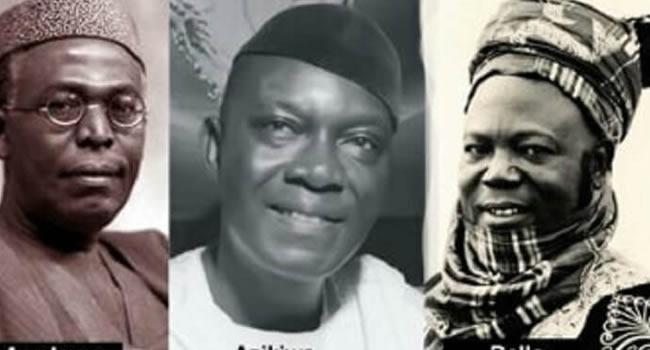
If ever there was going to be a transformational leader in Nigeria at the Federal level, that man would be Chief Obafemi Awolowo. He was brilliant beyond belief. He was a visionary and an executor. Simply put, he got the job done. If Western Region were a country, it was already ahead of many European countries on several levels in Awo’s time at the helm.
That was the problem.
What do you do with a problem? It has to be solved, accommodated or eliminated.
To begin with, when Awo protested the unfair allocation of seats in the run-up to the 1959 election;
When after the election he opted to try to work with the NCNC to form a national coalition to govern;
What was the response of the North?
Tafawa Balewa threatened to pull the North out of Nigeria. Usually, when the North issues a threat, they are able to back it up with riots.
Just for starters, there have been at least 11 documented riots in Kano since 1953, all of them resulting in significant loss of lives.
Talking about riots, the North has unwittingly boxed itself into a corner. By refusing to educate their people, they created and preserved a class of poor, uneducated and unexposed youth as canon fodder for violence. As they did this, the rest of the world left these young, vibrant and energetic youth behind. The advent of the internet has helped with the revolution of Northern youth in no small measure.
If Southern youth could do internet fraud, they could carry guns.
We are all now victims of an endless cycle of violence that can be cured by one big thing among many other interventions—-a radical declaration of a state of emergency on education of Northern youth.
Will Northern elite listen?
At the very least, we must hope that this line from Arthur Fletcher of the United Negro College Fund, (UNCF), will resonate with them—- “A mind is a terrible thing to waste.”
Maybe again—we can compare the Nigerian question to the lines from Matthew 11: 16-17—Jesus speaking—-“Whereunto shall I liken this generation? It is like unto children sitting in the markets, and calling unto their fellows, and saying, We have piped unto you, and ye have not danced; we have mourned unto you, and ye have not lamented.”
Ladies and gentlemen, we may not want to call it by its name because we want to be politically correct, but what is happening in the North today is a revolution.
Following the inconclusive Federal Election of 1959, Zik invited Awo and AG to Asaba for a coalition meeting.
Awo said he was willing to serve under Zik as Minister for Development. Whilst Awo and his people waited in Asaba, Zik concluded a merger with Tafawa Balewa to form a government.
Awo heard the news on radio.
Many scholars wonder till date how Zik who had the chance to be Prime Minister with real executive powers could have thrown that opportunity away to accept a ceremonial position. What forces were at play that caused him to adopt that position? Was he being blackmailed by the British according to some accounts?
Was Zik being his usual nationalistic minded persona who did not want to risk dividing the country by doing an alliance with the West?
or
Was he giving Awo his payback for the 1951 “betrayal” regarding the contrived false notion of cross-carpeting?
It should be noted here that the threat of secession was being dangled by the North at this time. Any time there was a riot in the North, Igbos always bore the brunt of the conflict—lost limbs, looted shops and extinguished lives.
Is it possible that he had calculated that peace in the country was more valuable than the role of Prime Minister given the propensity of the North to set off riots at the snap of a finger?
Having lost his bid to become Prime Minister, Awo settled robustly into the role of Federal Opposition.
Tafawa Balewa was irritated. He openly castigated Awo as “that brat who considers himself leader of the opposition.”
His attitude toward Awo remains instructive in today’s Nigeria. For the most part, when Nigerians run out of ideas in a conversation, they resort to insults and belittling behavior.
Further, there’s something about the African and our relationship with power. This is even truer today than it was in years gone by. There are few jobs. The only path to wealth or any manner of earning a living becomes direct or indirect access to power.
The tendency therefore is for members of the Party that has lost to begin to lose hope at remaining in opposition and start to gravitate towards the ruling Party.
Rather crumbs from the master’s table than nothing.
This attitude set the stage for the beginning of the fight between Akintola and Awo. Ladoke Akintola was a brilliant man. He wanted to be his own man.
Clearly, he had forgotten something. We were practicing the Parliamentary system of government. Awo was the leader of the Party.
There was room for only one Captain on the Ship. Akintola wanted the AG to embrace the NPC so as to attract Federal projects to the Western Region. Awo as leader of the Party wanted a pure, untainted opposition to adequately represent the interests of the people.
The die was cast.
To be or not to be.
That was the question.
Awo’s faction following parliamentary procedure removed S.L Akintola. The Regional Governor, Sir Adesoji Aderemi promptly appointed Alhaji Dauda Adegbenro as Premier. Akintola appealed.
Akintola won.
Adegbenro appealed the verdict to the Privy Council, (Supreme Court) in London.
Adegbenro won.
Tafawa Balewa was in charge.
Dark clouds were gathering.
On May 25th, 1962, as both factions gathered for a Confidence vote in parliament, a brawl broke out. Balewa sent in Riot police. They deployed tear gas and shut the politicians inside to inhale the gas. People were injured but no one died in the fracas. Four days later, on May 29th 1962, Balewa struck. He suspended the government of the Western Region and appointed Dr. Moses Majekodunmi as Sole Administrator.
By a stroke of the pen, Balewa neutralized Awo.
Here was a man who more than any of his contemporaries had fought for Independence. Here was a man who declared and implemented free education for his people, and built the best healthcare system for his people. He built the first Skyscraper in West Africa and created Agricultural communities for food production for home consumption and for exportation. Awo was simply, a man without peer in his generation.
In William Shakespeare’s play Julius Caesar (Act 1, Scene 2), the character Cassius says to Brutus:
“Men at some time are masters of their fates: / The fault, dear Brutus, is not in our stars, / But in ourselves, that we are underlings.”
Did Akintola have a vaulting ambition?
Was Awo unbending and unyielding?
It did not take long before whispers of a coup attempt by Awo grew loud enough for him to be sent to trial for treasonable felony.
Did he do it?
Was he being cooked up?
Here’s a little anecdote. While sitting in prison in Calabar, a so-called “Peace Committee” headed by Chief Justice Ademola Adetokunbo went to see Awo. They offered him a deal. “You will be released from prison if you agree to dissolve Action Group into a Pan-Yoruba Party that will be more amenable to working with the NPC.”
Hear the Justice who sent Awo to prison for 10 years in his own words: “My hands are tied.”
What did Justice George Sodeinde Sowemimo mean by that statement?
Many historians believe that the death knell of the First Republic was set in motion by Balewa’s gross miscalculation regarding the issues of the Western Region.
It was a leadership struggle.
No one was killed. The parliamentary system was working out itself. It was a document of systems and procedures.
Was Balewa right to intervene when he did and how he did?
If so, why did he not see fit to intervene when the NPC government of the North killed over 4,000 people, (by eyewitness accounts) with its heavy handedness against the Tiv people in 1960? (The official figure was 47 killed). The Tiv people were a Northern Christian minority led by Joseph Tarka. They were protesting a bad deal in Northern Region. They wanted a distinctive identity.
There is one forgotten portion of the history of those early years of a young nation.
Why did Tafawa Balewa offer Awo the post of Deputy Prime Minister in March of 1962?
Why did Zik also offer him the post of Deputy Governor General in May 1962?
The two posts listed above did not exist in the 1960 Constitution.
Being the core democrat that he was, Awo saw two things. First, an attempt to bribe him to shut up and secondly, an attempt to build a One Party State under the guise of a Grand Coalition government.
He declined both offers.
He could see through them already especially having been sidelined on October 1 at the 1960 Independence celebration when he and his wife were humiliated in the seating arrangement. He was made to sit in the back along with ex-servicemen. That was the day he said to his wife—“this Balewa man is a clever deceiver.”
Awo was caged. Akintola was restored to power after 6 months of emergency rule. The road was clear for Akintola to ride roughshod over the Western Region and ride, he did!
Hold on to that for a minute. Part 4 coming.
Michael Ovienmhada.
Author, Playwright and Filmmaker.
FYI: There’s a short movie everyone needs to watch. It’s titled: 3 Friends. Check it out on O’meekey TV. You will love it. See link below.