A Shaky foundation.
In the run up to the General Election of 1959, something curious happened to Arithmetic. Parliamentary seats were supposed to be allocated on the basis of one seat per 100,000 population.
The results of the 1952/1953 census were as follows: North—10.9m. Western Nigeria including Lagos —-6.09 million. Eastern Nigeria—-7.2 million. Based on these raw figures, the total combined seats for Western and Eastern Nigeria ought to be approximately 132 Seats based on a combined population of 13.2 million thus bringing the total number of seats to be vied for nationwide to 241 total.
Somehow, by British Arithmetic, they arrived at 312 total seats nationwide and by further bogus mathematics, they arbitrarily awarded the North an extra 64 Seats whilst allocating 7 Seats to the South.
Upon what new criteria were these new allocations based?
Effectively, given these new raw numbers, if all the Parties in the North agreed to go into an alliance every single election as “One Arewa,” the North would have won before the bell rang with 174 Seats super majority compared to the combined total Southern numbers of 138. Unlike the Southern politicians who needed to campaign in the North, the NPC did not need to campaign in the South.
However, let us remember here that this was on the platform of multiparty system. Whoever could cobble together a supermajority of 157 seats was going to form the government.
It is pertinent here not to mislead the reader. There were multiple political parties and they were not coerced into accepting an alliance with their next door neighbors.
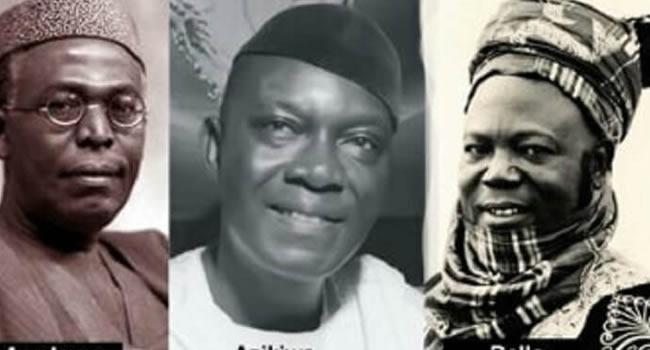
For example, the NEPU led by Aminu Kano found common ground with the NCNC led by Zik.
In the same vein, the Niger Delta Congress of the Eastern Region found kinship with the NPC. Likewise, the Mabolaje Grand Alliance of the Western Region went into an alliance with the NCNC led by Zik. All the above listed minority parties won seats which would become crucial to a giant party such as the NPC, NCNC or AG as the case may be.
Given the above scenario, the reader may begin to wonder why AG and NCNC did not protest the unfair, and arbitrary allocation of Seats just before a major election.
Awo did but he did not have support from Zik. Clearly, Zik was still seething from the narrative that he had won the Western Regional election of 1951 and had been “betrayed.”
Whereas, Zik knew otherwise—-factually. This is borne out of an interview that a journalist had with Sam Mbakwe, Governor of the old Imo State. He pleaded to be anonymous. He said—-“we decided to spread that false narrative that Zik won in the West and was betrayed because we needed a basis to take over from Eyo Ita in the East” He said “it was all politics.”
Essentially, Zik was willing to throw Awo under the bus despite the veracity of his position regarding the gross unfairness of the Seats allocation.
At this point, it becomes important to weigh in on the old narrative that has persisted to this day among intelligentsia of Nigeria spanning the years 1951 till date.
In 1951, elections were held nationwide under the McPherson Constitution. AG scored 38 of 80 Seats before alliances and horse trading began. NCNC scored 24 Seats. The Ibadan People’s Party led by Adegoke Adelabu won 6 Seats. Now, here’s the kicker. The IPP had made a decision to work with the NCNC to give them all 6 Seats won by them. This would only have given them a total of 30 Seats. That is one account.
Another account has it that NCNC won 35 Seats while AG won 29.
Again, let it be noted that we were operating under a Westminster system of Government —and so, until all the horse trading and alliances were completed where the word—“completed” means scoring a total of 52 Seats out of 80, the deal was not done. That meant that your political grouping had not met the requirements to form a government. During the period of the horse trading, the AG was able to secure 52 Seats.
Anyone who really and objectively wants to understand what happened in 1951 should cast a glance at Israeli elections.
See below:
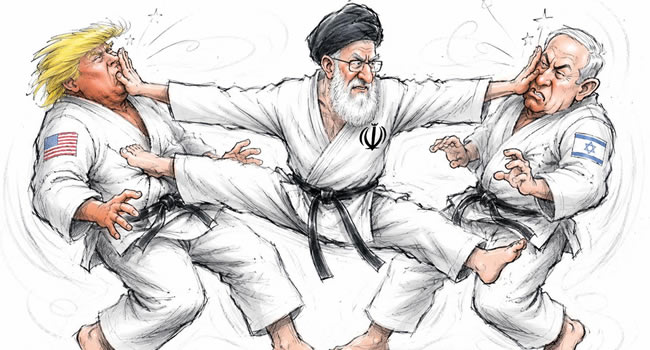
In Israel, the party with the highest number of seats failed to form a government in the 2009 election (when Kadima won the most seats, but Tzipi Livni failed to build a coalition and Benjamin Netanyahu formed the government instead) and the March 2021 election (when Likud won the most seats, but Benjamin Netanyahu failed to form a government and a coalition was ultimately formed by Yair Lapid and Naftali Bennett).
That is how things work under the Westminster form of government. Some argue that this system has the best outcome in terms of wider participation in governance than the brutal winner takes all situation of the presidential form of government.
Will the story above put to rest once and for all the widely held notion that Awo introduced tribalism into Nigerian politics?
For as long as we tend to look at winning or losing with the mindset of the presidential form of government, it will be hard to answer that question.
In the end, every political system will be operated by men.
Is it therefore possible that in our search for forms of government, we should actually be looking for forms of men instead?